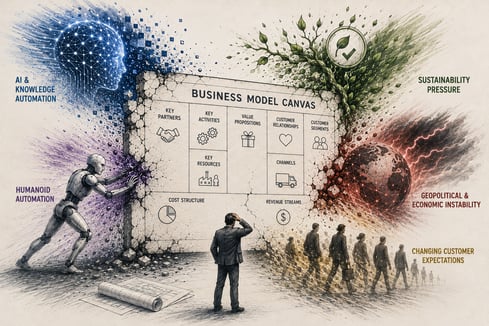
 Many SMEs are still operating with business logics designed for a more stable world. However, their ways of creating value, serving customers and planning growth were built around a world view which is already gone.
Today, we are witnessing the world and its rules changing quickly and dramatically. We are entering a longer period of instability, uncertainty and structural change rather than a short-term disturbance. What does this mean for us, entrepreneurs? It means that business models which worked well in the past may become less relevant much faster than we expect.
This is happening for several reasons, but let me name a few.
Structural Forces Reshaping SMEs
AI and the Changing Value of Knowledge
AI has already been widely adopted, and this is only the beginning. It is challenging the value of knowledge, expertise and services that many businesses were built around. Activities that once required years of experience, specialist staff or significant time investment can increasingly be done faster, cheaper and at scale. New and more powerful AI models continue to accelerate this process.
Robotics and Automation
Robotics and automation are also arriving much faster than many business owners realise. Many people still associate robots with large manufacturing plants and highly automated factories. However, humanoid robots are already becoming commercially available. They are increasingly independent and capable of performing basic tasks in real-world environments. If this technology maintains its current speed of development, it may trigger changes in work, operations and economic structures on a scale never seen before in human history.
Sustainability as a Business Condition
Sustainability is also becoming a much deeper business issue than many SMEs initially recognised. For years, it was often treated mainly as branding, marketing or CSR matters. Today, it increasingly influences supplier relationships, regulations, investment decisions, public procurement and customer trust. In many industries, sustainability is slowly moving from being optional to becoming part of the conditions for remaining competitive and legitimate in the market.
Geopolitical Instability and Economic Uncertainty
And last but not least, geopolitical instability is exposing how dependent many business models are on assumptions of global stability. Energy prices, material costs, supply chains, labour availability and international trade conditions can now shift rapidly and unpredictably. This has already become painfully obvious for SMEs engaged in international trade. However, even more locally focused businesses are increasingly affected through inflation, changing consumer behaviour, economic pressure and growing uncertainty across markets.
These changes do not happen separately. They interact with each other and reshape business conditions simultaneously.
When Business Models Slowly Lose Relevance
Don’t get me wrong, current business models do not have to fail immediately. Companies may still generate revenue, keep existing customers and operate in ways that appear stable on the surface. This can create the impression that the business model still works and that the company is managing the situation.
However, relevance can decline long before a visible crisis appears. Customer expectations may slowly shift, competitive advantages may weaken, operational standards may become outdated and parts of the offer may lose value without immediate warning signs. The danger for many SMEs is therefore not sudden collapse, but gradual strategic irrelevance developing quietly over time.
This is especially difficult because older business models often continue “working”, but require more and more effort and resources to maintain, which discourages deeper reflection or change. Businesses become focused on improving what already exists, while the environment around them changes faster than the logic on which the organisation was originally built.
And then one day, you realise the business is no longer possible to maintain in its current form - and it may already be too late for change.
Business Design & Strategic Adaptability
This creates a deeper challenge for SMEs. The issue is often not only about delivering the product or service well, but about continuously rethinking the business model itself - the way the company creates, delivers and captures value.
In other words, many SMEs may need to shift from protecting existing models towards continuously testing whether those models still fit the reality around them.
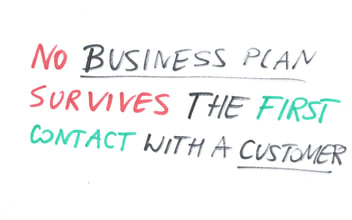
Business models need to evolve continuously through the ability to question assumptions, notice change early and adapt before pressure turns into crisis. In this context, the ability to learn quickly become more important than long-term planning. SMEs may increasingly need to test assumptions, experiment with new ideas and learn directly from market feedback rather than relying only on past experience and established ways of operating.
The goal is not constant disruption or change for the sake of change, but the ability to adapt before adaptation becomes unavoidable.
This may require SME owners to rethink not only what the business does, but also the assumptions on which the business was originally built.
- If we started this business today, would we design it the same way?
- Which assumptions about customers are no longer true - or may soon change?
- What part of our business model depends on stability that no longer exists?
- Are we able to notice change early enough to react?
- How will we recognise that customer expectations are changing?
The real challenge for SMEs may no longer be only efficiency, optimisation or growth. Increasingly, it may be the ability to remain relevant in a world changing faster than many business models were designed for.
Building Adaptive Business Models
If you would like support in rethinking your business model, building experimentation capabilities or improving strategic adaptability, we organise dedicated workshops for SMEs focused on helping organisations explore new opportunities, test ideas and adapt to changing market conditions. Feel free to contact us to discuss how this could support your organisation.