
Industry 5.0: Human-Centric, Sustainable and Resilient industry of the future
Beyond Automation: From Industry 4.0 to Industry 5.0 Towards a Human-Centric, Sustainable and Resilient Technological Future
Over the past decade, organisations have adopted an increasingly sophisticated stack of technologies (e.g. AI and machine learning, robotics and co-bots, cyber-physical systems, IoT infrastructures, integrated IT/OT environments, digital twins, adaptive algorithms and data-intensive decision systems).
This broad wave, often summarised as Industry 4.0, has undeniably expanded what we are capable of designing, producing and coordinating. It enabled higher precision, connectivity and operational efficiency. Yet these gains have also exposed a growing imbalance: technological capability has advanced faster than our human, organisational and environmental capacity to absorb and govern it.
Complexity has multiplied, resource demands have intensified, and the lived experience of people within these systems has not always improved in parallel. The benefits are real, but so are the costs - and both must be acknowledged if we are to design more coherent futures.
Industry 5.0 as a Reorientation of Technological Advancement
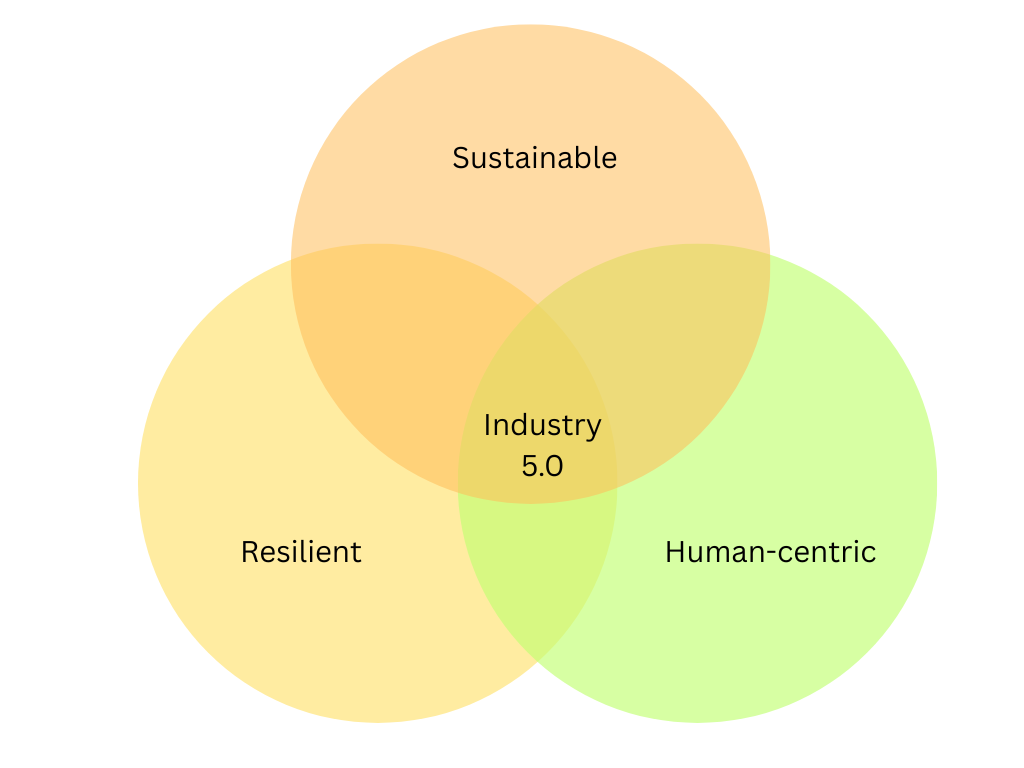
Industry 5.0, in the way it has been defined by the European Commission, is a conceptual attempt to respond to this situation. It is not a new layer of technology, nor a departure from digital innovation, but a shift in orientation: a recognition that advanced systems must enhance human well-being, operate within planetary boundaries, and remain robust in the face of growing geopolitical and environmental volatility.
Human-centricity ensures technology strengthens rather than erodes human agency; sustainability situates innovation within the limits and opportunities of our ecological context and long-term value creation; and resilience acknowledges the need for socio-technical systems capable of withstanding disruption.
Together, these principles reframe Industry 4.0 rather than replace it: offering a more grounded and future-ready foundation for research, innovation and organisational development and the capacity to design, test and scale innovation responsibly in a world defined by complexity.

Embracing Industry 5.0 Principles in Horizon Europe Proposals
Integrating Industry 5.0 principles into Horizon Europe proposals strengthens the conceptual coherence of a project by situating it within the wider societal, environmental and geopolitical context in which innovation unfolds. It signals that the consortium is not approaching research purely through technological capability, but through an understanding of how human agency, ecological limits and system-level vulnerabilities shape the feasibility and responsibility of technological progress.
A proposal framed through an Industry 5.0 lens shows evaluators that the consortium grasps the realities of real-world deployment: that new solutions must make sense for people, align with economic and policy transitions, and remain robust under conditions of geopolitical and environmental volatility. This strengthens the project’s credibility across Excellence, Impact and Implementation - aligning it with European priorities for human-centric innovation, ecological responsibility and long-term resilience.
Better Organisations for Industry 5.0
Our work with Industry 5.0 grows out of a long-standing commitment to designing innovation that makes sense for people, organisations and the planet. We approach Industry 5.0 as a conceptual lens that helps research teams articulate the societal relevance, sustainability and resilience of their work.
This orientation has become increasingly important in Horizon Europe, where proposals are assessed not only for technical excellence but for their alignment with wider human, ecological and geopolitical realities.
As researchers and designers, we work with consortia to express and operationalise the Industry 5.0 dimension in ways that strengthen both the scientific coherence and the practical intelligibility of the proposal.
Our contribution is to make the Industry 5.0 perspective explicit, rigorous and well-integrated: clarifying the human and societal needs the project responds to, embedding sustainability and resilience considerations, and supporting co-creation processes that improve real-world relevance, usability and adoption.
Through design-led framing, prototyping and sense-making, we help teams translate conceptual intentions into concrete research activities and innovation pathways. In practice, this means enabling your proposal to articulate a stronger narrative across Excellence, Impact and Implementation - without overstating claims or compromising scientific integrity.
Integrating and Co-Creating Industry 5.0 in R&I
Our contribution in 4Sir2

4Sir2 Smoothy is a Horizon Europe funded project developing a functional beverage for children with obesity, using grape or apple juice enriched with bioactive compounds derived from red grape by-products to support healthier metabolic function through sirtuin activation.
Better Organisations leads the Industry 5.0 dimension by analysing how human-centric, sustainable and resilient principles can inform decisions across cultivation, processing and production. We design and facilitate targeted co-creation workshops and map socio-technical dependencies to ensure that Industry 5.0 considerations are coherently integrated into the project’s research activities and value-chain decisions.
