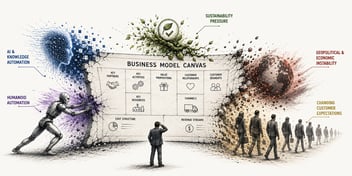
In 2020, many leaders and entrepreneurs discovered something uncomfortable: the more you plan, the more uncertainty you can hide inside the plan. COVID-19 created a world where basic assumptions changed weekly: customer behaviour, supply chains, regulations, even what “normal operations” meant. At the same time, the growing American-Chinese conflict signalled deeper shifts in economic relations and the move towards a more multipolar world.
In conditions like this, a traditional business plan quickly becomes a story we tell ourselves. Business design asks for a different discipline: treat the plan as a hypothesis, get it into contact with customers early, and use evidence-based decision making to adapt.
The world will change even further, because in the background we have the growing American-Chinese conflict – which at best, in my opinion, will be the beginning of a multipolar world – which will affect economic relations.
It looks like the COVID-19 restrictions will be loosened soon, which should help businesses do business. Perversely, loosening measures does not remove uncertainty for business. I assume that spreading the disease will last, so we can expect imposing and withdrawing restrictions (to control the acceleration of spreading), or we can face local lockdowns. This scenario is a realistic one. I refer to the example of Wuhan (where, on 28th March, after months of lockdown, residents were told they could leave their homes, only for the decision to be reversed 5 days later) or Shulan (which has been locked down this week). Imagine it might be a possibility in the near future, where Glasgow, Birmingham, or York are in lockdown, and if you had a business partner, a client or a supplier in that city you need to deal with the immediate impact on your business.
The coronavirus has changed our world already, and the world will change even further, because in the background we have the growing American-Chinese conflict – which at best, in my opinion, will be the beginning of a multipolar world – which will affect economic relations
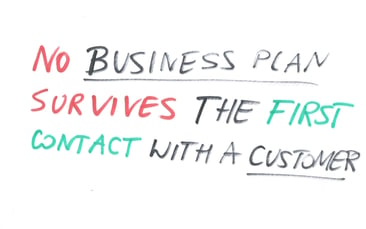
No business plan survives the first contact with a customer
Most of the time in business, we spend time focusing on good execution. Once we know what we do, we try to do it better. When we plan, we plan to execute more efficiently what we know.
There is a saying: no business plan survives the first contact with a customer [1]. My thesis is as follows: most of the time in business, we spend time focusing on good execution. Once we know what we do, we try to do it better. When we plan, we plan to execute more efficiently what we know. And this is OK, as long as we understand what the right things to do are.
But what if we try to do something relatively new? Or if the business conditions have rapidly changed (e.g. customer behaviour changes)? Then we need to re-learn what the correct things to do are.
Typical marketing research (which should be a part of any proper business planning process) often takes a long time, generating a significant cost and often capturing:
-
data about past successes and past failures (which can be very irrelevant for the current situation), or
-
data from a different context (which might be very irrelevant to the context of our business).
If we are building something new, this is where innovation efforts often go wrong: we invest in planning and implementation before we have real learning.
If we focus on planning and implementation, it may very soon turn out that the foundation of our business plan is purely assumptions (we focus on building plans based on our interpretation of a future reality which was not validated in any way). Running a business based on unverified assumptions is a simple recipe for trouble.
“If, when building a new business solution, we focus on planning and implementation, it may very soon turn out, that the foundation of our business plan is purely assumptions.”
If we focus on planning and implementation, it may very soon turn out, that the foundation of our business plan is purely assumptions (we focus on building plans based on our interpretation of a future reality which was not validated in any way). Running a business based on unverified assumptions is a simple recipe for trouble.
A better approach: customer discovery and validation loops
“No business plan survives the first contact with a customer” is an observation, but very often painfully real. The chances of you coming out immediately (at the first attempt) with an idea for a ready-to-build business are very small. That is a reason why we need to use more adaptable approaches when we start to build a strategy.
This is where business design becomes practical. Instead of defending the plan, you set up validation loops: customer discovery, rapid tests, real-user feedback cycles, learning, and iteration. This is business model validation and value proposition validation in the real world.
Do you think you will need to build something new, or adapt your company in some way? Look at how the risk might spread in different situations, where and when you may have to adapt.
-
Low risk: if you have significant experience serving the market which is not changing rapidly, and if you are going to deliver a relatively small adjustment. There are still risks, but they can be easily mitigated.
-
Medium (sometimes changing to high risk): delivering an existing solution to a new customer segment, building a new value proposition for an existing market, building a new value proposition for a new customer segment.
-
High risk: making a pivot, building an alternative business model where more than two building blocks in the Business Model Canvas have changed. Especially if the change is irreversible, connected with large investment. If this is true, it’s often a one-way decision.
-
Extremely high risk: when we work on radical innovation which is going to change the paradigm (how we frame what we do).
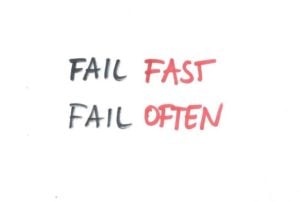
Where are you on this scale? Are you going to create a new idea and then plan how to deliver your change? Are you going to focus on executing the plan? Or are you going to test the assumptions early, learn fast, and then execute with confidence?
If conditions are changing, treat your plan as a hypothesis. Put it in front of customers early and let evidence, not hope, guide your next move.
Sources:
[1] That was said by Steve Blank, when he paraphrased Helmuth Graf von Moltke, who said: “No campaign plan survives first contact with the enemy”